The Strength of Yumine
Sewing Technology and Factory Management
About Sewing Technology
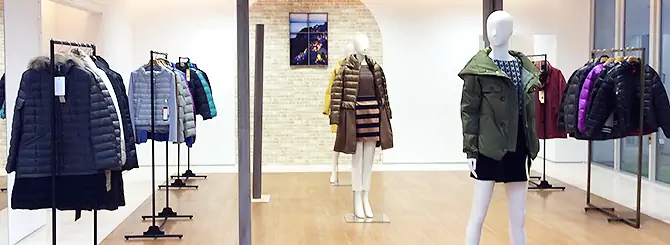
Our company primarily manufactures woven garments across one facility in China and two in Vietnam.
Within the category of woven products, there is a wide range of segments and client needs—such as suits, casual wear, and sportswear, with even more detailed classifications possible.
Across our three production bases, each factory leverages its own area of expertise, enabling us as a group to produce a broad spectrum of woven products.
Sewing Guidance Tailored to Customer Requirements
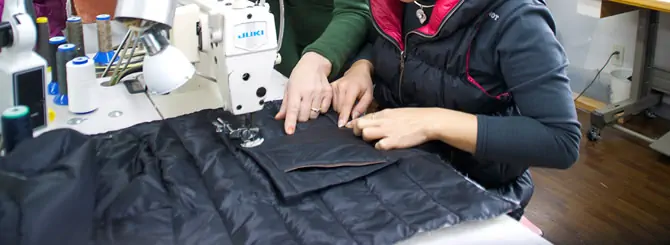
The key requirements in the sewing process vary depending on both the product category and the customer.
While adhering to fundamentals is essential across all cases, we believe it is equally important to determine how we can adapt, refine, and add value in line with specific category and client needs.
To meet these expectations, we place strong emphasis on providing thorough technical guidance as well.
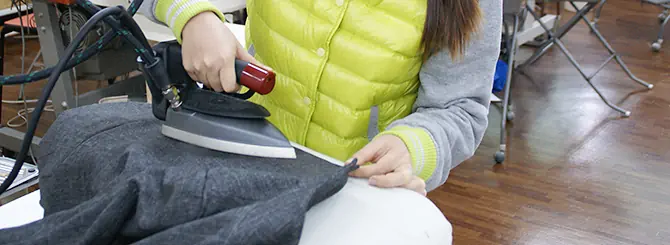
For example, in women’s suits, a three-dimensional construction that follows the natural contours of the body is essential.To achieve this, it is necessary to incorporate multiple pressing (ironing) processes—sewing, shaping with the iron, sewing again, and pressing once more. Through ironing, we create curves and form, giving the garment its dimensional structure.In contrast, while sportswear also involves ironing processes, applying the same number of pressing steps as in women’s suits would instead lead to unnecessary inefficiencies and production loss.
Factory Management System
For both administrative and sewing departments, our fundamental approach is visual management.
By implementing systems that allow conditions to be understood at a glance, those involved in operations and management remain highly aware, enabling them to quickly identify and resolve issues on-site.
This approach also helps prevent problems before they occur.
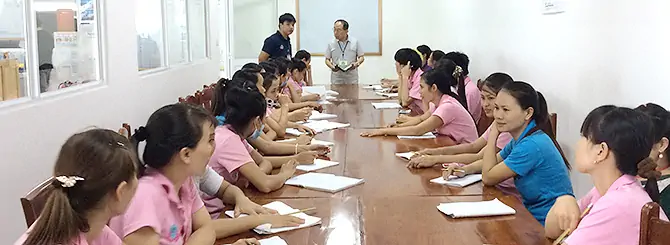
Reliable Line Production, Driven by People
In our sewing department, we operate a basket-flow production system. Each line is assigned a number of baskets equal to the number of operators, with each basket containing parts for five garments. These baskets move sequentially along a U-shaped line. If baskets begin to accumulate at a particular point (operator), it indicates a bottleneck. We immediately identify the issue at that station and take corrective action. Conversely, if an operator has no baskets, it signals idle time; in such cases, they assist upstream processes or we reassess task allocation. This system enables balanced workflow management and rapid response to inefficiencies on the line.
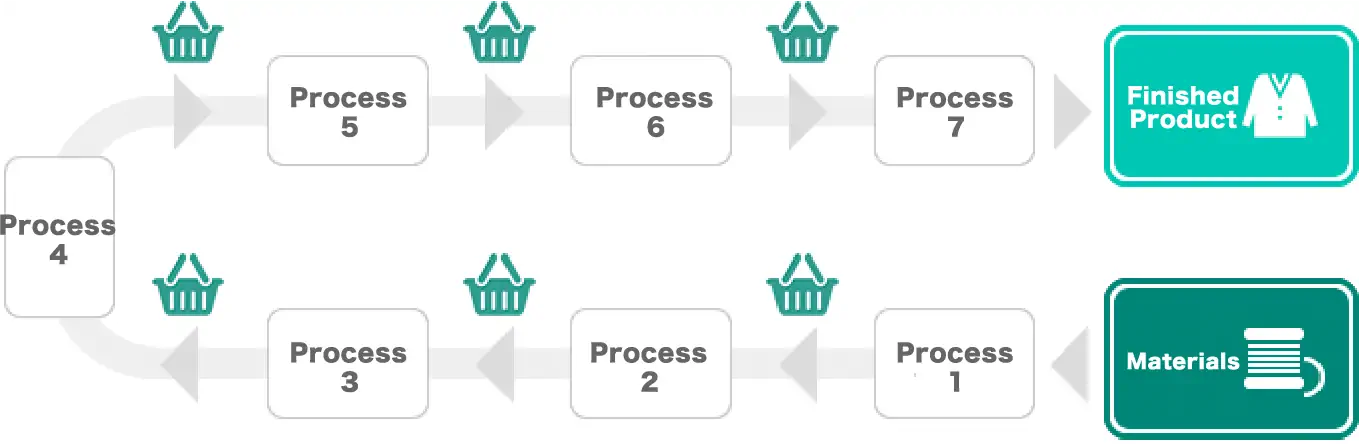
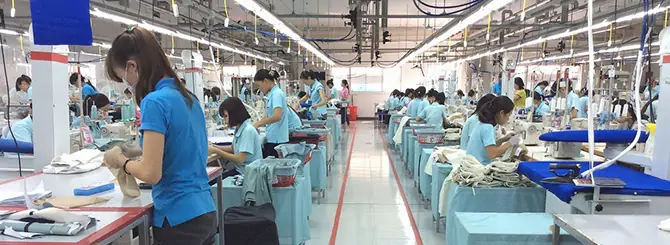
Baskets are expected to flow at a consistent pace, with one basket per station (operator) representing the normal state; any deviation from this is considered abnormal. A typical line consists of 15 to 20 operators. Since the workflow progresses sequentially from one person to the next, relying solely on single-skill operators makes it difficult to maintain a smooth flow. Therefore, operators are required to be multi-skilled, capable of handling both preceding and subsequent processes. However, individual strengths and aptitudes vary. The line leader evaluates each operator’s abilities and assigns tasks accordingly, ensuring optimal process allocation within the line.
Our compensation system incorporates an incentive structure in which output per production line is directly reflected in wages. The results are translated into clearly visible earnings based on a fixed calculation method.
At the same time, relying solely on line-based incentives can lead to imbalances at the individual level. To address this, we also evaluate each employee’s capabilities and provide additional compensation as skill-based pay. This system is part of our broader approach to visual management, ensuring transparency and clarity.
In terms of equipment and supplies management, we have established our system based on guidance from a major retail company and have obtained certification accordingly.
Management can only function when rules are properly followed. Without adherence to rules, effective management is impossible. For this reason, particularly in equipment management, we emphasize thorough record-keeping as a standard practice. Records are maintained, verified with signatures, and regularly checked. Through this continuous cycle, we reinforce compliance with established rules.